Hong Kong Opens its Pillar 2 E-Filing Portal
On January 19, 2026, the Hong Kong Inland Revenue Department opened its E-filing portal for the submission of Top-Up Tax Notifications
This is then expressed as a percentage and rounded to the fourth decimal place.
Under Article 5.1.2 of the OECD Model Rules, the jurisdictional net Pillar Two GloBE income is the total Pillar Two GloBE income of all constituent entities in the jurisdiction, less any Pillar Two GloBE losses of constituent entities in the jurisdiction.
If there is a net Pillar Two GloBE loss, this is the end of the calculation and the Pillar Two GloBE effective tax rate (ETR) need not be calculated. In most cases this would mean no top-up tax would be due. The exception to this is where a Pillar Two domestic tax loss exceeds the Pillar Two GloBE loss. You can see more about this at Additional Tax.
If the jurisdictional ETR is below the 15% minimum rate, the jurisdiction is treated as a low-tax jurisdiction and the constituent entities are treated as low-taxed constituent entities.
The top-up tax percentage is simply the difference between the jurisdictional Pillar Two GloBE ETR and the 15% global minimum rate, as provided by Article 5.2.1 of the OECD Model Rules.
The top-up tax percentage is applied to ‘excess profit’ to determine the initial top-up tax due. The basic excess profit calculation is:
Note, when a domestic tax loss exceeds the GloBE loss, Article 2.7 of the OECD Administrative Guidance provides that an MNE can elect for the Excess Negative Tax Expense administrative procedure.
Key Aspects
Key aspects of this calculation worth noting are:
• If an MNE elected not to apply the substance-based income exclusion, excess profit would just be the net Pillar Two GloBE income for the jurisdiction. For more information on the substance-based income exclusion see, Substance-Based Income Exclusion
• The substance-based income exclusion cannot create a Pillar Two GloBE loss. If the substance-based exclusion amount exceeds Pillar Two GloBE income, the excess is simply lost.
• The jurisdictional blending approach also applies to the substance-based income exclusion. Therefore, if a constituent entity had little Pillar Two GloBE income but a large substance-based exclusion amount, this would be offset against the net Pillar Two GloBE income of the jurisdiction including other constituent entities in the jurisdiction.
See our simple Top-Up Tax Calculator for a high-level illustration of the mechanics of the top-up tax calculation.
The actual top-up tax calculation builds on all of the above, and is calculated as follows:
See Additional Top-Up Tax and Qualified Domestic Top-Up Tax for more information.
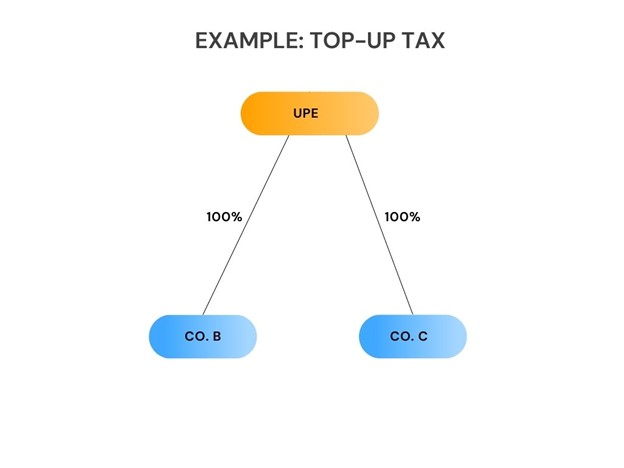
UPECo is the UPE of an MNE group located in Country A. It owns the entire share capital in two subsidiaries located in Country B, Company B and Company C. The MNE group is within the scope of the Pillar Two GloBE rules. Neither Company B nor Company C are investment entities.
Company A has:
Pillar Two GloBE income of 5,000,000 euros
Adjusted covered taxes of 1,000,000 euros
Investments in qualifying local tangible assets of 10,000,000 euros
Company B has:
Pillar Two GloBE income of 10,000,000 euros
Adjusted covered taxes of 1,000,000 euros
Investments in qualifying local tangible assets of 20,000,000 euros
The approach to calculating the amount of any top-up tax is as follows:
1. Calculate the top-up tax percentage
This is based on the jurisdictional Pillar Two GloBE income and Adjusted Covered Taxes.
The total Pillar Two GloBE income is 15,000,000 euros
The total Adjusted Covered Taxes are 2,000,000 euros
The Pillar Two GloBE ETR is therefore 13.3333% and the top-up tax percentage is 1.6667%
2. Calculate excess profit
This takes account of the substance-based income exclusion, again on a jurisdictional basis.
For the sake of simplicity lets ignore any transitional rules and have the rate for the tangible asset carve-out as 5%.
The substance-based income exclusion would therefore be 30,000,000 * 5% = 1,500,000 euros
Excess profit is therefore 15,000,000 – 1,500,000 = 13,500,000 euros.
3. Calculate top-up tax
If we assume there is no additional top-up tax or any tax payable under a qualifying domestic top-up tax (QDMTT), the top-up tax for Country B is 225,004 euros (13,500,000 * 1.6667%).
This illustrates the effect of jurisdictional blending. The income and taxes of the two companies in Country A are blended with the result that the high-tax company (Company A that had an ETR of 20% before the substance-based exclusion) offsets the low-tax company (Company B with an ETR of 10%).


On January 19, 2026, the Hong Kong Inland Revenue Department opened its E-filing portal for the submission of Top-Up Tax Notifications

On December 31, 2025, Israel enacted Law No. Law 5776-2025 on the Minimum Corporate Tax for Multinational Groups. The enacted law contains some significant changes from the previous draft law.

On December 29, 2025, Uruguay’s President issued Decree No. 325/025, to provide for exemptions from the QDMTT for entities covered by a tax stability agreement. Note that Law N° 20446 to enact the QDMTT was published in the Official Gazette on January 8, 2026.

On December 23, 2025, Korea enacted Law number 21215 to implement the 2026 Tax Reform. This includes a QDMTT from January 1, 2026.

On January 5, 2026, the OECD Released Guidance on amendments to the Pillar 2 rules for the Side-by-Side Tax Package. This includes a new Simplified ETR Safe Harbour from December 31, 2026 (December 31, 2025 in certain cases). We provide an excel overview and a sample calculator for the key elements of the Safe Harbour calculation.

On January 5, 2026, the OECD Released Guidance on amendments to the Pillar 2 rules for the Side-by-Side Tax Package. This includes a new Substance-based Tax Incentive Safe Harbour. This online tool shows how the new safe harbour operates.

On January 5, 2026, the OECD Released Guidance on amendments to the Pillar 2 rules for the Side-by-Side Tax Package. This article looks at a number of the new elections that arise from this.

On January 5, 2026, the OECD Released Guidance on amendments to the Pillar 2 rules for the Side-by-Side Tax Package.

On December 23, 2025, Germany enacted a law to amend the Minimum Tax Act. This follows the two previous discussion drafts and now includes the January 2025 OECD Administrative Guidance and DAC9 amendments.
| Cookie | Duration | Description |
|---|---|---|
| cookielawinfo-checkbox-analytics | 11 months | This cookie is set by GDPR Cookie Consent plugin. The cookie is used to store the user consent for the cookies in the category "Analytics". |
| cookielawinfo-checkbox-functional | 11 months | The cookie is set by GDPR cookie consent to record the user consent for the cookies in the category "Functional". |
| cookielawinfo-checkbox-necessary | 11 months | This cookie is set by GDPR Cookie Consent plugin. The cookies is used to store the user consent for the cookies in the category "Necessary". |
| cookielawinfo-checkbox-others | 11 months | This cookie is set by GDPR Cookie Consent plugin. The cookie is used to store the user consent for the cookies in the category "Other. |
| cookielawinfo-checkbox-performance | 11 months | This cookie is set by GDPR Cookie Consent plugin. The cookie is used to store the user consent for the cookies in the category "Performance". |
| viewed_cookie_policy | 11 months | The cookie is set by the GDPR Cookie Consent plugin and is used to store whether or not user has consented to the use of cookies. It does not store any personal data. |