Brazil Implements the SBTI Safe Harbour
On 18 September 2026, Brazil issued IN RFB No. 2,342/2026 to introduce a new framework for the treatment of substance-based tax incentives under its Pillar Two rules.

Article 7.5.2 of the OECD Model Rules provides that this is a five-year election and it treats the GloBE income of the investment entity as accruing to the constituent entity owner in proportion to its ownership entitlement.
It is only available where the constituent entity owner is subject to tax on a fair value accounting method on its interest in the investment entity (such as under a mark-to-market accounting policy) and the tax rate levied on the income for the owner is at least 15%.
The purpose behind the election is to align the GloBE rules with the domestic tax treatment for the owner of the investment entity. The election applies to both directly held and indirectly held investment entities.
Under domestic law, the constituent entity owner would be subject to tax on the income of the investment entity anyway (calculated on fair value changes). This election simply pushes up the income to the constituent entity owner for the GloBE income calculation to match the timing under domestic law.
One of the criticisms of this election is that in some countries, such as Germany, changes of the fair value of the ownership interest in the investment entities are not taxed. In others, such as France, some investors are taxed on changes of the fair value as required but others are not and are taxed on the historic
value of their ownership interests.
Therefore, this election is either not applicable in some jurisdictions or only on a few investment entities or insurance investment entities in others.
Note that once an election is made a constituent entity owner of an investment entity shouldn’t include any fair value adjustment even if when looked at separately it may use a fair value basis for accounting purposes. If there are any fair value adjustments included in the financial accounting income or loss they should be excluded from GloBE income.
To include such adjustments would result in the income being included in GloBE income twice given the tax transparency election already allocates the share of the investment entity income to the constituent entity.
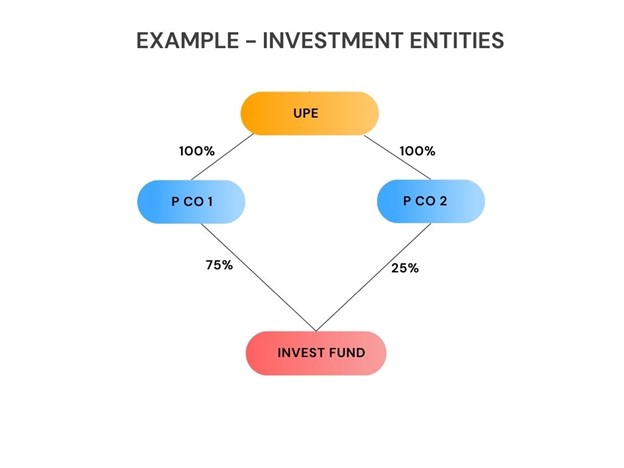
In this case, if we assume P Co 1 and P Co 2 were subject to the mark-to-mark basis on their investment in the investment fund, they could file a tax transparency election.
The income of the fund, which is likely to be calculated on a fair value basis under accounting standards, would be included in P Co 1 and P Co 2’s GloBE income.
If the income was for instance 1,000,000 euros, P Co 1 would include 750,000 euros and P Co 2 would include 250,000 of income.
The substance-based income exclusion also applies to the constituent entity owners on a tax transparent basis. In other words, the constituent entity owner can take into account its share of the payroll costs and tangible assets in the jurisdiction when calculating excess profits.
The Tax Transparency Election treats the GloBE income of the investment entity as accruing to the constituent entity owner in proportion to its ownership entitlement.
The purpose behind the election is to align the GloBE rules with the domestic tax treatment for the owner of the investment entity.

On 18 September 2026, Brazil issued IN RFB No. 2,342/2026 to introduce a new framework for the treatment of substance-based tax incentives under its Pillar Two rules.


On 15 September 2026, the Dutch government presented a bill that would introduce four new Pillar Two safe harbours, extend the Transitional Country-by-Country Reporting Safe Harbour and amend the treatment of certain 52- and 53-week accounting periods.

On September 11, 2026, the OECD released a package of guidance and implementation materials that provides for the exclusion of Explicitly Conditional Taxes from Covered Taxes, clarifies the treatment of mismatched fiscal periods under the Qualified Domestic Minimum Top-up Tax Safe Harbour, updates the GloBE Information Return and establishes the detailed framework for full legislative reviews of domestic minimum tax rules.

Uruguay’s presidential decree dated 31 August 2026 replaces the conditional QDMTT payment waiver in Decree No. 325/025 with a compensation mechanism. Article 1 requires in-scope constituent entities allocated QDMTT in Uruguay to comply with its QDMTT obligations and pay the tax; article 7 repeals the earlier decree.

Qatar has published six decisions dealing with currency conversion, simplified reporting, the Transitional CbCR Safe Harbour, non-material constituent entities, designated local entities and registration.

The Slovak Government has approved draft legislation that would make significant changes to Slovakia’s qualified domestic minimum top-up tax regime. The proposals would implement the OECD’s new Substance-Based Tax Incentives Safe Harbour, extend the Transitional CbCR Safe Harbour and introduce rules preserving Pillar Two filing and payment obligations where a Slovak taxpayer ceases to exist without a legal successor.

Cyprus has opened a public consultation on amendments to its Pillar Two legislation intended to address observations from the European Commission and align the domestic rules more closely with OECD guidance. The consultation opened on 30 July 2026 and is scheduled to close on 5 September 2026.

On August 7, 2026, Germany published a regulation that gives domestic legal effect to a jurisdiction-by-jurisdiction list of qualifying Pillar Two jurisdictions.

On August 8, 2026, Mauritius issued its QDMTT regulations to implement its QDMTT.

| Cookie | Duration | Description |
|---|---|---|
| cookielawinfo-checkbox-analytics | 11 months | This cookie is set by GDPR Cookie Consent plugin. The cookie is used to store the user consent for the cookies in the category "Analytics". |
| cookielawinfo-checkbox-functional | 11 months | The cookie is set by GDPR cookie consent to record the user consent for the cookies in the category "Functional". |
| cookielawinfo-checkbox-necessary | 11 months | This cookie is set by GDPR Cookie Consent plugin. The cookies is used to store the user consent for the cookies in the category "Necessary". |
| cookielawinfo-checkbox-others | 11 months | This cookie is set by GDPR Cookie Consent plugin. The cookie is used to store the user consent for the cookies in the category "Other. |
| cookielawinfo-checkbox-performance | 11 months | This cookie is set by GDPR Cookie Consent plugin. The cookie is used to store the user consent for the cookies in the category "Performance". |
| viewed_cookie_policy | 11 months | The cookie is set by the GDPR Cookie Consent plugin and is used to store whether or not user has consented to the use of cookies. It does not store any personal data. |