


Norway Pillar Two Filing Guide
A guide to Norway’s three compliance workstreams for Pillar Two (suppleringsskatteloven): the GloBE Information Return (GIR), the foreign-filer notification, and the Norwegian top-up tax return.
Intragroup financing arrangements are subject to special rules under Article 3.2.7 of the OECD Model Rules.
This is a common area of tax planning for MNE’s and without specific provisions, they could adjust the effective tax rate (ETR) of jurisdictions by structuring financing operations.
For instance, they could reduce Pillar Two GloBE income in jurisdictions that were just below the minimum rate (therefore increasing the ETR and potentially resulting in the jurisdictional ETR being over 15%) whilst increasing Pillar Two GloBE income in jurisdictions that had significant ETR capacity (ie where the jurisdictional ETR is significantly above 15% anyway).
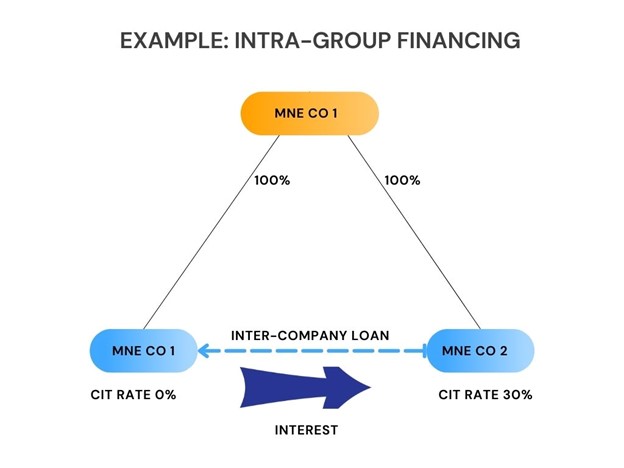
A typical arrangement that would be targeted by this is a hybrid financing arrangement such as:
MNE Co 1 is resident in a low-tax jurisdiction. It borrows money from MNE Co 2 by way of a debt instrument 2. MNE Co 2 is a member of the same MNE group and is resident in a high tax jurisdiction.
The debt instrument is treated as equity for tax purposes and debt for financial accounting purposes in both jurisdictions.
As such, interest payments by MNE Co 1 would reduce Pillar Two GloBE income (and therefore increase the Pillar Two GloBE ETR) without any reduction in the domestic tax liability (as dividends are generally not tax-deductible).
By contrast, the interest receipt would increase Pillar Two GloBE income in MNE Co 2 (reducing its Pillar Two GloBE ETR) without a corresponding increase in its domestic taxable income.
Therefore, as an anti-avoidance measure, the Pillar Two GloBE income or loss of a low-taxed entity does not include any expenses of an intra-group financing arrangement that can be expected to increase the expenses of a low-taxed entity without a corresponding increase in the taxable income of a high taxed entity.
A low-taxed entity is generally an entity in a jurisdiction where the Pillar Two GloBE ETR is less than 15%.
There is no increase in the taxable income of a high-taxed entity if the income qualifies for an exclusion or deduction ie just because the high-taxed entity is allocated the income for local tax purposes does not mean this requirement is met, if it qualified for deduction or credits that offset it.
This could be the case if, for example, it has brought forward interest expenses sufficient to offset interest received from the low-taxed entity.
Whether there is an intragroup financing arrangement in place is an objective test and is based on whether there is an arrangement between two or more members of an MNE group which results in a high taxed entity directly or indirectly providing credit or making an investment in a low taxed entity.
In addition, again using an objective test, the arrangement must be reasonably expected to reduce the Pillar Two GloBE income of a low taxed entity without increasing the taxable income of a high taxed entity over the duration of the agreement.
Profits from international shipping (eg profits derived from the transport of cargo or passengers by ships) as well as certain ancillary income are generally exempt for Pillar Two GloBE income purposes under Article 3.3 of the OECD Model Rules.
As this would have been included in the profits in the financial accounts, an adjustment to the Pillar Two GloBE income is required.

A guide to Norway’s three compliance workstreams for Pillar Two (suppleringsskatteloven): the GloBE Information Return (GIR), the foreign-filer notification, and the Norwegian top-up tax return.

A review of the remedial timing amendment that aligns New Zealand’s GloBE incorporation rules with the OECD’s January 2026 Side-by-Side Package.

On April 17, 2026, the Brazil opened up a consultation on proposed changes to its QDMTT regime to implement the Substance-based Tax Incentives (SBTI) Safe Harbour.

On 9 and 10 April 2026, the Dutch Tax Administration’s Pillar Two Knowledge Group published two administrative positions on the treatment of joint ventures under the Dutch Minimum Tax Act 2024.

A guide to Italy’s three-track Pillar Two process: the reporting-entity notification, the DAC9/GIR (Comunicazione Rilevante), and the domestic GloBE Return (Dichiarazione fiscale Globe) with related F24 payments.

A guide to Australia’s Pillar Two filing. It covers the separate local GIR XML filing, the foreign lodgement notification, and the Combined Global and Domestic Minimum Tax Return (CGDMTR), including the Australian IIR/UTPR tax return and Australian DMT tax return. It also flags the main ATO validation rules and the software / API points that matter if you are building or testing a filing process.

A guide to Spain’s three-part Pillar Two workflow: model 240 (group/filing notification), model 241 (GIR-DAC9 information return), and model 242 (top-up tax self-assessment).

On April 7, the Swiss Federal Tax Administration issued Communication-031-E-2026-f and Communication-030-E-2026-f to apply the OECD January 2025 and January 2026 Administrative Guidance

On April 8, 2026, Germany issued a Draft Regulation which included a list of jurisdictions with qualifying status for the purposes of the IIR, UTPR, QDMTT and the QDMTT Safe Harbour.
| Cookie | Duration | Description |
|---|---|---|
| cookielawinfo-checkbox-analytics | 11 months | This cookie is set by GDPR Cookie Consent plugin. The cookie is used to store the user consent for the cookies in the category "Analytics". |
| cookielawinfo-checkbox-functional | 11 months | The cookie is set by GDPR cookie consent to record the user consent for the cookies in the category "Functional". |
| cookielawinfo-checkbox-necessary | 11 months | This cookie is set by GDPR Cookie Consent plugin. The cookies is used to store the user consent for the cookies in the category "Necessary". |
| cookielawinfo-checkbox-others | 11 months | This cookie is set by GDPR Cookie Consent plugin. The cookie is used to store the user consent for the cookies in the category "Other. |
| cookielawinfo-checkbox-performance | 11 months | This cookie is set by GDPR Cookie Consent plugin. The cookie is used to store the user consent for the cookies in the category "Performance". |
| viewed_cookie_policy | 11 months | The cookie is set by the GDPR Cookie Consent plugin and is used to store whether or not user has consented to the use of cookies. It does not store any personal data. |