

Pillar Two: Trusts and Foundations

Article 10 of the OECD Model Rules defines an entity as either: 

– a legal person (except an individual); or

– any arrangement that prepares separate financial accounts.

Note that the First Set of OECD Administrative Guidance also excludes government agencies (both central and local government) that carry out government functions.

The first limb above would generally catch foundations, whilst the second would catch trusts. 

This means that trusts and foundations are squarely within the Pillar Two rules and could be a low-taxed entity, an intermediate entity/partially owned parent entity or even an ultimate parent entity (UPE). 

Under Article 1.4.1 of the OECD Model Rules, a UPE for the Pillar Two rules is:

  • an entity that owns directly or indirectly a controlling interest in another entity; and
  • is not owned, with a controlling interest, directly or indirectly by another entity.

Whether a trust is a UPE is an important consideration as (1) in many cases the UPE is required to apply the income inclusion rule to account for top-up tax and (2) the definition of an MNE group hinges on the relationship between the group companies and the UPE.

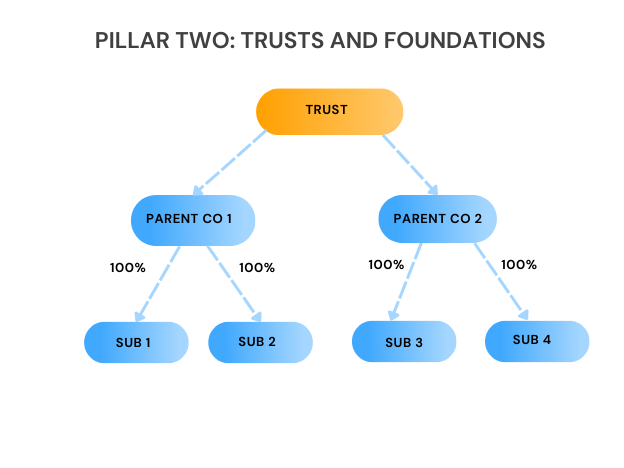
For instance, take this scenario:

image showing example group structure of a trust owning parent entities with a title stating ' Pillar Two - Trusts and Foundations'

Determining if the trust was the UPE could result in all companies then potentially being within the scope of the Pillar Two rules (subject to any specific exclusions etc). Aside from the application of Pillar Two to the group, the trust could then be liable to account for top-up tax.

This in itself could create issues.

The definition of a group in the Pillar Two rules relies on accounting principles so that there is a group if there is a requirement to prepare consolidated financial statements.

Whilst a trust or foundation may not usually have to prepare consolidated financial statements under an accounting standard, the Pillar Two rules go further.

Article 10 of the OECD Model Rules states that if no consolidated financial statements are prepared a deeming provision applies so that the entity must prepare hypothetical consolidated financial statements as if it was required to prepare them in accordance with an Authorised Financial Accounting Standard that is either an Acceptable Financial Accounting Standard or another financial accounting standard.

As such, a trust or foundation would need to determine if it would be required to prepare accounting standards under an accounting standard.

This would again depend on accounting principles.

Under IFRS for instance, there is a requirement to consolidate if the trust or foundation possesses power over the parent entities, has exposure to variable returns from its involvement with them and has the ability to use its power over them to affect its returns.

Latest Articles

turkey flag

Turkey Issues a Communique for Detailed Pillar 2 Implementation

On December 26, 2025, Turkey published the Communique on the Minimum Tax Law. Whilst Turkey has enacted its Minimum Tax Law, a lot of the detailed application of the GloBE rules was left to a further Regulation. This Communique therefore provides for the detailed rules for the implementation of the GloBE rules in Turkey.

Read More »

Liechtenstein Gazettes amendments to the Pillar 2 Law and Regulation

On December 23, 2025, Liechtenstein’s Official Gazette included amendments to the Pillar 2 law and regulation to implement domestically the OECD provisions for the exchange of information in the GloBE Information Return (GIR) under the multilateral agreement between competent authorities on the exchange of GloBE information (GIR MCAA).

Read More »
portugal flag

Portugal Extends its Pillar 2 Registration Deadline

Order No. 158/2025 XXV issued on December 12, 2025 provides that for constituent entities whose fiscal year ended between December 31, 2024 and March 31, 2025 the filing deadline for Form 62 (the Pillar 2 Registration Form) is the last day of the 15th month following the end of that fiscal year.

Read More »