
Indonesia Issues Regulation PER-6/PJ/2026 on Pillar Two Administrative Requirements
On May 4, 2026, Indonesia Issued Regulation PER-6/PJ/2026 on Pillar Two Administrative Requirements.
Article 7.5.2 of the OECD Model Rules provides that this is a five-year election and it treats the GloBE income of the investment entity as accruing to the constituent entity owner in proportion to its ownership entitlement.
It is only available where the constituent entity owner is subject to tax on a fair value accounting method on its interest in the investment entity (such as under a mark-to-market accounting policy) and the tax rate levied on the income for the owner is at least 15%.
The purpose behind the election is to align the GloBE rules with the domestic tax treatment for the owner of the investment entity. The election applies to both directly held and indirectly held investment entities.
Under domestic law, the constituent entity owner would be subject to tax on the income of the investment entity anyway (calculated on fair value changes). This election simply pushes up the income to the constituent entity owner for the GloBE income calculation to match the timing under domestic law.
One of the criticisms of this election is that in some countries, such as Germany, changes of the fair value of the ownership interest in the investment entities are not taxed. In others, such as France, some investors are taxed on changes of the fair value as required but others are not and are taxed on the historic
value of their ownership interests.
Therefore, this election is either not applicable in some jurisdictions or only on a few investment entities or insurance investment entities in others.
Note that once an election is made a constituent entity owner of an investment entity shouldn’t include any fair value adjustment even if when looked at separately it may use a fair value basis for accounting purposes. If there are any fair value adjustments included in the financial accounting income or loss they should be excluded from GloBE income.
To include such adjustments would result in the income being included in GloBE income twice given the tax transparency election already allocates the share of the investment entity income to the constituent entity.
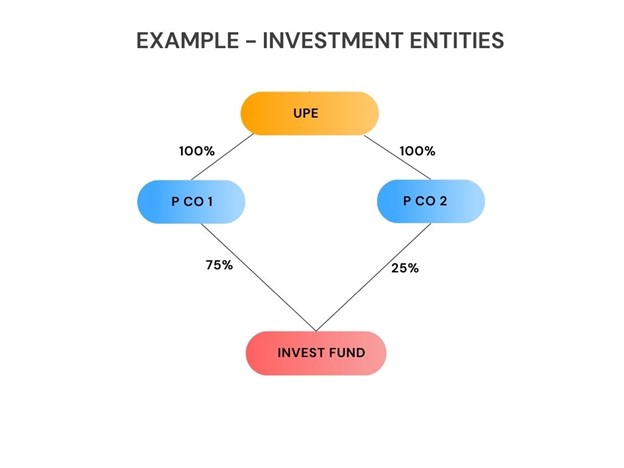
In this case, if we assume P Co 1 and P Co 2 were subject to the mark-to-mark basis on their investment in the investment fund, they could file a tax transparency election.
The income of the fund, which is likely to be calculated on a fair value basis under accounting standards, would be included in P Co 1 and P Co 2’s GloBE income.
If the income was for instance 1,000,000 euros, P Co 1 would include 750,000 euros and P Co 2 would include 250,000 of income.
The substance-based income exclusion also applies to the constituent entity owners on a tax transparent basis. In other words, the constituent entity owner can take into account its share of the payroll costs and tangible assets in the jurisdiction when calculating excess profits.
The Tax Transparency Election treats the GloBE income of the investment entity as accruing to the constituent entity owner in proportion to its ownership entitlement.
The purpose behind the election is to align the GloBE rules with the domestic tax treatment for the owner of the investment entity.

On May 4, 2026, Indonesia Issued Regulation PER-6/PJ/2026 on Pillar Two Administrative Requirements.

On May 6, 2026, Canada issued its Budget 2025 Implementation Act, No. 2 into Parliament. This includes numerous amendments to its Global Minimum Tax Regime.

On May 6, 2026, Switzerland opened a consultation on amendments to the Swiss Minimum Taxation Ordinance, to delay the Swiss application of the OECD January 2025 Administrative Guidance on Article 9.1 of the GloBE Model Rules for one year.

On May 1, 2026, Australia issued the draft Taxation (Multinational—Global and Domestic Minimum Tax) Amendment (2026 Measures No. 2) Rules 2026 for consultation. This includes a one-year extension to the Transitional CbCR safe-harbour and a number technical amendments to the Australia’s Pillar Two rules

On April 30, 2026, the OECD released its Global Minimum Tax Implementation Toolkit. The Toolkit is directed primarily at tax administrations and tax policy officials implementing the global minimum tax

South Africa’s April Pillar Two amendments are focused on implementing the June 2024 OECD Administrative Guidance (sections 63–65 of the Taxation Laws Amendment Act, 2026 and section 25 of the Tax Administration Laws Amendment Act, 2026).

In April 2026, Finland issued detailed guidance on the Finnish implementation of the GloBE Information Return (GIR)

On April 10, 2026, Croatia issued a Draft Ordinance to provide for various administrative aspects of its Pillar Two regime.

The Netherlands has announced the opening of its Pillar Two filing from June 2026.
| Cookie | Duration | Description |
|---|---|---|
| cookielawinfo-checkbox-analytics | 11 months | This cookie is set by GDPR Cookie Consent plugin. The cookie is used to store the user consent for the cookies in the category "Analytics". |
| cookielawinfo-checkbox-functional | 11 months | The cookie is set by GDPR cookie consent to record the user consent for the cookies in the category "Functional". |
| cookielawinfo-checkbox-necessary | 11 months | This cookie is set by GDPR Cookie Consent plugin. The cookies is used to store the user consent for the cookies in the category "Necessary". |
| cookielawinfo-checkbox-others | 11 months | This cookie is set by GDPR Cookie Consent plugin. The cookie is used to store the user consent for the cookies in the category "Other. |
| cookielawinfo-checkbox-performance | 11 months | This cookie is set by GDPR Cookie Consent plugin. The cookie is used to store the user consent for the cookies in the category "Performance". |
| viewed_cookie_policy | 11 months | The cookie is set by the GDPR Cookie Consent plugin and is used to store whether or not user has consented to the use of cookies. It does not store any personal data. |