UK publishes draft legislation to implement the OECD’s Side-by-Side Pillar Two package
On July 13, 2026, the UK government published draft Finance Bill 2026–27 legislation implementing the OECD’s January 2026 Side-by-Side package.
Article 10 of the OECD Model Rules defines an entity as either:
– a legal person (except an individual); or
– any arrangement that prepares separate financial accounts.
Note that the First Set of OECD Administrative Guidance also excludes government agencies (both central and local government) that carry out government functions.
The first limb above would generally catch foundations, whilst the second would catch trusts.
This means that trusts and foundations are squarely within the Pillar Two rules and could be a low-taxed entity, an intermediate entity/partially owned parent entity or even an ultimate parent entity (UPE).
Under Article 1.4.1 of the OECD Model Rules, a UPE for the Pillar Two rules is:
Whether a trust is a UPE is an important consideration as (1) in many cases the UPE is required to apply the income inclusion rule to account for top-up tax and (2) the definition of an MNE group hinges on the relationship between the group companies and the UPE.
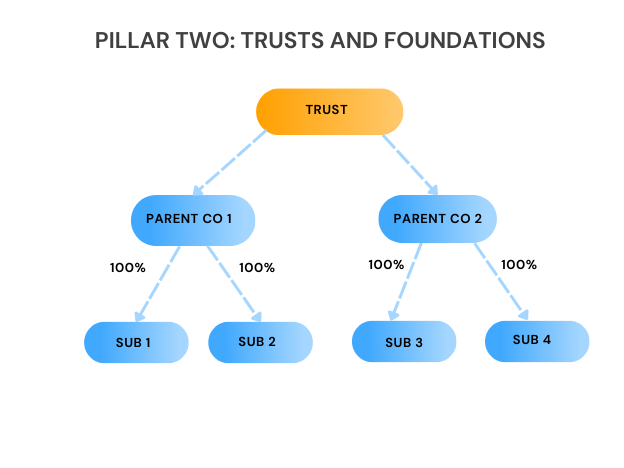
For instance, take this scenario:
Determining if the trust was the UPE could result in all companies then potentially being within the scope of the Pillar Two rules (subject to any specific exclusions etc). Aside from the application of Pillar Two to the group, the trust could then be liable to account for top-up tax.
This in itself could create issues.
The definition of a group in the Pillar Two rules relies on accounting principles so that there is a group if there is a requirement to prepare consolidated financial statements.
Whilst a trust or foundation may not usually have to prepare consolidated financial statements under an accounting standard, the Pillar Two rules go further.
Article 10 of the OECD Model Rules states that if no consolidated financial statements are prepared a deeming provision applies so that the entity must prepare hypothetical consolidated financial statements as if it was required to prepare them in accordance with an Authorised Financial Accounting Standard that is either an Acceptable Financial Accounting Standard or another financial accounting standard.
As such, a trust or foundation would need to determine if it would be required to prepare accounting standards under an accounting standard.
This would again depend on accounting principles.
Under IFRS for instance, there is a requirement to consolidate if the trust or foundation possesses power over the parent entities, has exposure to variable returns from its involvement with them and has the ability to use its power over them to affect its returns.

On July 13, 2026, the UK government published draft Finance Bill 2026–27 legislation implementing the OECD’s January 2026 Side-by-Side package.

On July 1, 2026, Australia issued the Taxation (Multinational—Global and Domestic Minimum Tax) Amendment (2026 Measures No. 2) Rules 2026. This incorporates elements of the OECD Agreed Administrative Guidance issued in December 2023, June 2024 and January 2026.

On June 26, 2026, Cyprus issued Decree 272/2026 to confirm entry-into-force dates for the main January 2026 OECD safe harbour package

On June 22, 2026, the UAE issued Ministerial Decision No. 96 of 2026 to implement the OECD Side-by-Side Tax Package.

On June 26, 2026, Turkey announced an extension to the filing of its GloBE tax return and payment from June 30, 2026 to July 31, 2026.

On June 16, 2026, the Dutch Ministry of Finance opened an internet consultation on the Draft Safe-Harbour Bill. The consultation closes on 14 July 2026 and provides draft legislation to implement the OECD Side-by-Side package into the Dutch domestic regime.

On June 15, 2026, the Cyprus Tax Department issued two announcements on the domestic implementation of the Pillar Two framework. The first concerned the European Commission’s position on Cyprus’ Income Inclusion Rule (IIR). The second addressed filing deadlines and compliance obligations for Cypriot constituent entities and joint ventures under Law 151(I)/2024.

On June 10, 2026, the EU issued the ‘Manual for MNE Groups on Global Minimum Tax (Pillar Two) Compliance Obligations‘. This provides country level analysis of Pillar Two filings in Austria, Belgium, Croatia, Cyprus, Czech Republic, Finland, France, Germany, Greece, Ireland, Poland, Romania, Slovenia and Sweden.

A practical overview of the Dutch GloBE Information Return (GIR) filing process, including BIA terminology, deadlines, XML format, Digipoort submission, security, validation, notification obligations and governance controls.
| Cookie | Duration | Description |
|---|---|---|
| cookielawinfo-checkbox-analytics | 11 months | This cookie is set by GDPR Cookie Consent plugin. The cookie is used to store the user consent for the cookies in the category "Analytics". |
| cookielawinfo-checkbox-functional | 11 months | The cookie is set by GDPR cookie consent to record the user consent for the cookies in the category "Functional". |
| cookielawinfo-checkbox-necessary | 11 months | This cookie is set by GDPR Cookie Consent plugin. The cookies is used to store the user consent for the cookies in the category "Necessary". |
| cookielawinfo-checkbox-others | 11 months | This cookie is set by GDPR Cookie Consent plugin. The cookie is used to store the user consent for the cookies in the category "Other. |
| cookielawinfo-checkbox-performance | 11 months | This cookie is set by GDPR Cookie Consent plugin. The cookie is used to store the user consent for the cookies in the category "Performance". |
| viewed_cookie_policy | 11 months | The cookie is set by the GDPR Cookie Consent plugin and is used to store whether or not user has consented to the use of cookies. It does not store any personal data. |