

Indonesia Issues Regulation PER-6/PJ/2026 on Pillar Two Administrative Requirements
On May 4, 2026, Indonesia Issued Regulation PER-6/PJ/2026 on Pillar Two Administrative Requirements.
Article 10 of the OECD Model Rules defines an entity as either:
– a legal person (except an individual); or
– any arrangement that prepares separate financial accounts.
Note that the First Set of OECD Administrative Guidance also excludes government agencies (both central and local government) that carry out government functions.
The first limb above would generally catch foundations, whilst the second would catch trusts.
This means that trusts and foundations are squarely within the Pillar Two rules and could be a low-taxed entity, an intermediate entity/partially owned parent entity or even an ultimate parent entity (UPE).
Under Article 1.4.1 of the OECD Model Rules, a UPE for the Pillar Two rules is:
Whether a trust is a UPE is an important consideration as (1) in many cases the UPE is required to apply the income inclusion rule to account for top-up tax and (2) the definition of an MNE group hinges on the relationship between the group companies and the UPE.
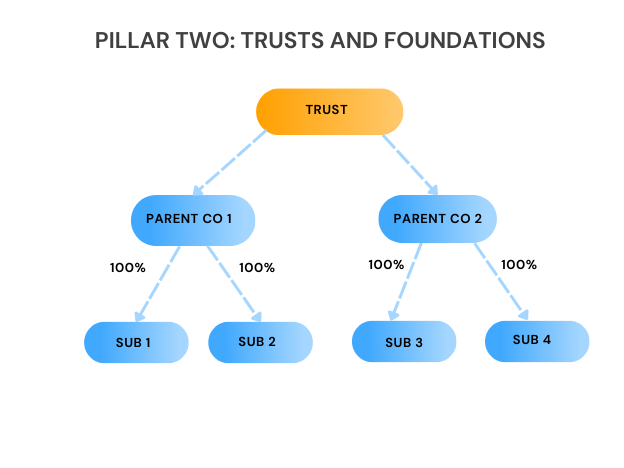
For instance, take this scenario:
Determining if the trust was the UPE could result in all companies then potentially being within the scope of the Pillar Two rules (subject to any specific exclusions etc). Aside from the application of Pillar Two to the group, the trust could then be liable to account for top-up tax.
This in itself could create issues.
The definition of a group in the Pillar Two rules relies on accounting principles so that there is a group if there is a requirement to prepare consolidated financial statements.
Whilst a trust or foundation may not usually have to prepare consolidated financial statements under an accounting standard, the Pillar Two rules go further.
Article 10 of the OECD Model Rules states that if no consolidated financial statements are prepared a deeming provision applies so that the entity must prepare hypothetical consolidated financial statements as if it was required to prepare them in accordance with an Authorised Financial Accounting Standard that is either an Acceptable Financial Accounting Standard or another financial accounting standard.
As such, a trust or foundation would need to determine if it would be required to prepare accounting standards under an accounting standard.
This would again depend on accounting principles.
Under IFRS for instance, there is a requirement to consolidate if the trust or foundation possesses power over the parent entities, has exposure to variable returns from its involvement with them and has the ability to use its power over them to affect its returns.

On May 4, 2026, Indonesia Issued Regulation PER-6/PJ/2026 on Pillar Two Administrative Requirements.

On May 6, 2026, Canada issued its Budget 2025 Implementation Act, No. 2 into Parliament. This includes numerous amendments to its Global Minimum Tax Regime.

On May 6, 2026, Switzerland opened a consultation on amendments to the Swiss Minimum Taxation Ordinance, to delay the Swiss application of the OECD January 2025 Administrative Guidance on Article 9.1 of the GloBE Model Rules for one year.

On May 1, 2026, Australia issued the draft Taxation (Multinational—Global and Domestic Minimum Tax) Amendment (2026 Measures No. 2) Rules 2026 for consultation. This includes a one-year extension to the Transitional CbCR safe-harbour and a number technical amendments to the Australia’s Pillar Two rules

On April 30, 2026, the OECD released its Global Minimum Tax Implementation Toolkit. The Toolkit is directed primarily at tax administrations and tax policy officials implementing the global minimum tax

South Africa’s April Pillar Two amendments are focused on implementing the June 2024 OECD Administrative Guidance (sections 63–65 of the Taxation Laws Amendment Act, 2026 and section 25 of the Tax Administration Laws Amendment Act, 2026).

In April 2026, Finland issued detailed guidance on the Finnish implementation of the GloBE Information Return (GIR)

On April 10, 2026, Croatia issued a Draft Ordinance to provide for various administrative aspects of its Pillar Two regime.

The Netherlands has announced the opening of its Pillar Two filing from June 2026.
| Cookie | Duration | Description |
|---|---|---|
| cookielawinfo-checkbox-analytics | 11 months | This cookie is set by GDPR Cookie Consent plugin. The cookie is used to store the user consent for the cookies in the category "Analytics". |
| cookielawinfo-checkbox-functional | 11 months | The cookie is set by GDPR cookie consent to record the user consent for the cookies in the category "Functional". |
| cookielawinfo-checkbox-necessary | 11 months | This cookie is set by GDPR Cookie Consent plugin. The cookies is used to store the user consent for the cookies in the category "Necessary". |
| cookielawinfo-checkbox-others | 11 months | This cookie is set by GDPR Cookie Consent plugin. The cookie is used to store the user consent for the cookies in the category "Other. |
| cookielawinfo-checkbox-performance | 11 months | This cookie is set by GDPR Cookie Consent plugin. The cookie is used to store the user consent for the cookies in the category "Performance". |
| viewed_cookie_policy | 11 months | The cookie is set by the GDPR Cookie Consent plugin and is used to store whether or not user has consented to the use of cookies. It does not store any personal data. |